Connectors Study

an international study into the emergence of children’s everyday practices of participation in circuits of social action

Main Menu

Skip to content
  • home
  • about us
    • about the study
      • Ελληνικά
      • తెలుగు
      • copyright note
    • about the team
    • advisory group
    • contact us
  • blog
  • dissemination
    • children’s photo-story book
    • project publications
    • related publications
    • keynotes and public lectures
    • conference presentations
    • invited seminars
    • podcasts
      • political activism across the lifecourse
      • children’s cartography & childhood publics
      • play as a research method
      • childhood publics
      • kinship mapping
  • events
    • activism on the edge of age
    • in common: children’s photo-stories of public life
    • Making connections: an introduction to multimodal ethnography
  • publics creating methodologies
    • earliest political memories
      • earliest political memories
    • kitchen table stories

Where do encounters with public life take place?

29th August 2017 · by smnolas · in kitchen table stories, writing on the wall. ·

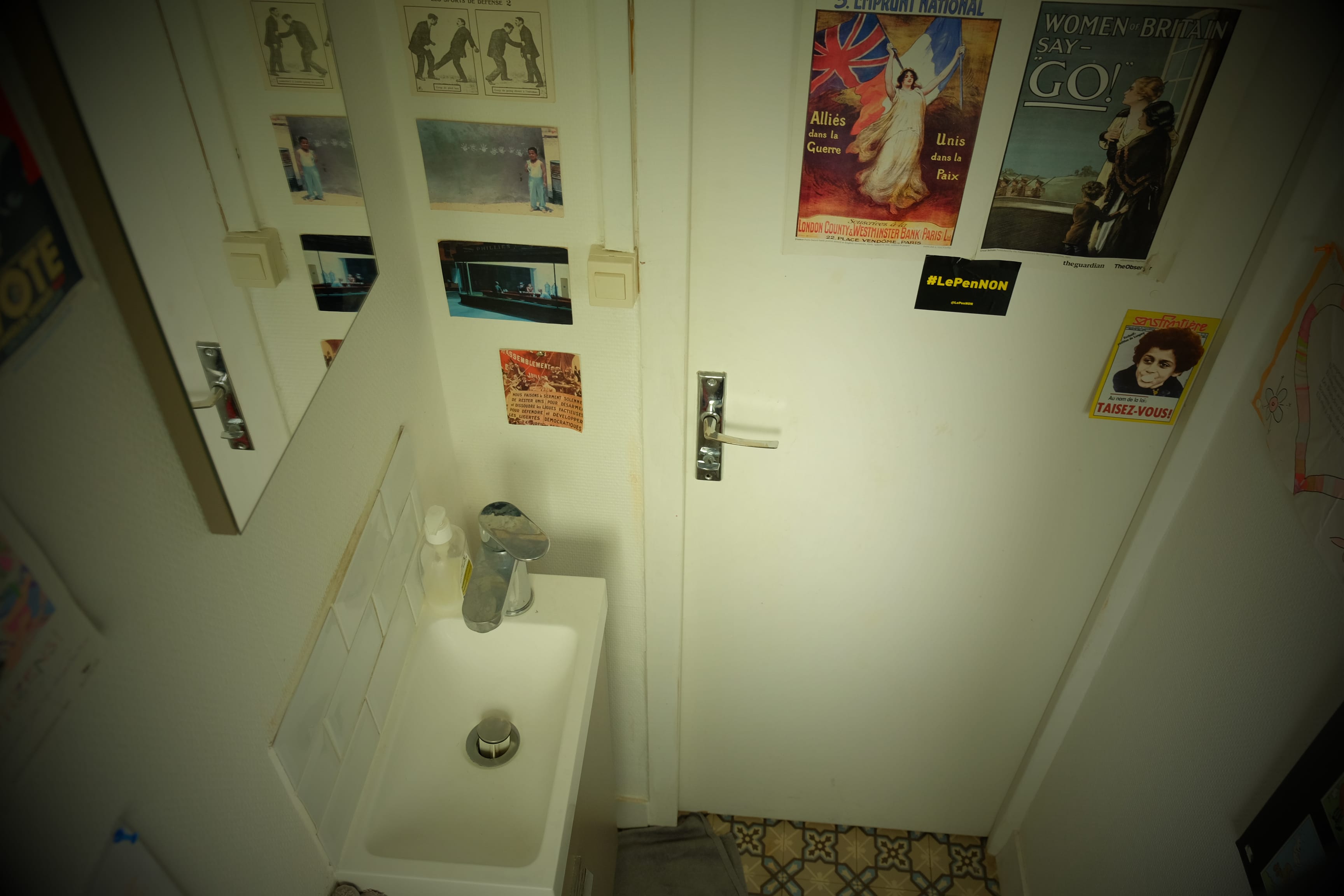
A bathroom in Paris, July 2017.

Last year we started experimenting with online crowd-sourcing methodologies (what I’m calling a ‘publics creating methodology’).

We asked for submissions of earliest political memories because we were interested in thinking about the biographical and historical dimensions of encountering public life in childhood.

This year, we are shifting our attention from time to space and place. We are curious about the geographies of encountering public life and the political in everyday life.

Where do encounters with public life take place?

This curiosity stems both from our own fieldwork experiences of encountering political talk, and hearing about experiences of talking politics in families, as well as from feminist literature reflecting on moments of politicisation.

For some children in our study, such encounters and engagement happened in between and through play; for parents, kitchen tables and meal times were often invoked.

Sara Ahmed writes that her feminist story begins with a table. Kitchen tables have also been documented as the sites where friendships are born and alliances built. Kitchens, on the other hand, are both spaces of regulation and socialisation, as well as places where intergenerational transmission of feminist traditions might occur.

Other intimate spaces inside and outside the home, that are fascinating in terms of political encounters are bathrooms and bathroom stalls. Their walls are often written on or pasted over with political slogans and expressions (a nice blog post about this here).

One child in our study used writing on the wall to experiment with transgressing boundaries.

Less private: pubs, bars and cafés. The coffee house is, of course, central to Habermas’s theory of the public sphere. It is also central to everyday lived experiences particularly in rural communities.

For example, the long-standing tradition of the kafeneio in Greece itself, as well as in its diasporas, is a known place where social, political and technical changes and ephemera, might be encountered assimilated, debated, or resisted.

More recently, the kafeneio has been re-invented as a political and social response to ‘crisis’, collective cafés cropping up in numerous areas around Athens and other urban centres (Kioupkiolis, 2016).

Tea shop on the road side in Tirupattur, Tamil Nadu, January 2017.

In India, tea shops often found on the side of the road, are places where men (typically) gather in the early morning to read the local newspaper and discuss politics before dispersing for work. Both tea shops and traditional kafeneia, especially in rural and suburban areas, are deeply gendered spaces, and men are still some of the key patrons.

At the same time, re-reading Homi Bhabha’s essay ‘Signs Taken For Wonders’ recently, I was struck by its sub-title: ‘questions of ambivalence and authority under a tree outside Delhi, May 1817’.

The essay itself interrogates and unpicks the boundaries of the colonial through the trope of ‘the English book’. It attempts to identify the spaces of ‘repetition and difference’ in the colonial presence and its experience.

I was struck by the image of the ‘tree outside Delhi’ as an everyday site of encountering public life, of boundary crossing and jostling. It disrupted my own experiences and ideas of the space and places of political encounters being somehow enclosed either in the home or a commercial space, sheltered perhaps from the elements of long, cold northern hemisphere winters.

—

So, this year we are launching a further online crowd sourcing activity, intended to help flesh out space and place experiences of encountering politics in everyday life.

These could be past encounters, recent encounters or most memorable encounters.

Tell us about your encounters here.

We leave the definition of politics open, it is whatever politics means to you.

We are asking for short submissions accompanied by a photo. We call these ‘photo-stories’ and you can read about our photo-story methodology here.

The photo does not have to correspond to the story, it can be illustrative or abstract, and you can submit a story without a photo.

Our crowd sourcing activity will run from today onwards. We will then re-blog one photo-story a day until all submissions have been blogged.

You can also choose to opt out the blogging part of the activity.

We will use the Guardian Community Standards and Participation Guidelines to moderate submissions and any comments to blogged photo-stories.


SaveSaveSaveSave

SaveSave

SaveSave

SaveSave

SaveSave

Share:

Related

What are your earliest political memories?

What are your earliest political memories?

It is often said that we carry our childhoods with us into adulthood, our past resonating in our present and future to a greater or lesser extent. Longitudinal research, such as cohort studies, is often concerned with how past and present experience will influence the opportunities we have in life (science journalist Helen…

In "cultural work"

On transitions, change and continuity...

On transitions, change and continuity...

This time five years ago I was busy drafting job descriptions for the recruitment of those strangers that would eventual make up the wonderful team of colleagues that have been behind the Connectors Study: Claire Prater, Christos Varvantakis, Vinnarasan Aruldoss, and later Robyn Long. Back then, five years seemed like…

In "cultural work"

In Common: what's in a name?

In Common: what's in a name?

How do children encounter, experience, and engage with public life? How having things ‘in common’ has influenced our forthcoming exhibition and book

In "cultural work"

Tags: methodology, Public Engagement, reflexivity

Post navigation

← Photo/Stories from the field: Adults in child research
Photo/Stories from the field: A dog’s statue (and the story behind it) →

Popular Posts & Pages

  • home
  • blog
  • in common: children’s photo-stories of public life
  • On transitions, change and continuity...
  • Photo/stories from the field: portrait of an ethnographer
  • Making connections: an introduction to multimodal ethnography
  • advisory group
  • Making connections under the banyan tree and other such spaces
  • Which children?
  • Photo/stories from the field: anonymous portraits and other practices in the ethics of representation

Archives

  • November 2018 (1)
  • September 2018 (4)
  • August 2018 (5)
  • July 2018 (5)
  • June 2018 (9)
  • May 2018 (21)
  • April 2018 (19)
  • March 2018 (20)
  • February 2018 (20)
  • January 2018 (21)
  • December 2017 (3)
  • November 2017 (2)
  • October 2017 (1)
  • September 2017 (3)
  • August 2017 (6)
  • July 2017 (5)
  • June 2017 (2)
  • April 2017 (3)
  • January 2017 (2)
  • December 2016 (10)
  • November 2016 (22)
  • October 2016 (21)
  • September 2016 (16)
  • July 2016 (2)
  • June 2016 (1)
  • May 2016 (1)
  • July 2015 (1)
  • June 2015 (1)
  • April 2015 (1)
  • March 2015 (1)
  • February 2015 (2)
  • January 2015 (1)
  • December 2014 (4)
  • October 2014 (3)
  • September 2014 (2)
  • July 2014 (1)
  • June 2014 (1)
  • May 2014 (1)
  • April 2014 (1)

Categories

  • athens (7)
  • cultural work (7)
  • desire lines (8)
  • earliest political memories (178)
  • fieldwork (32)
  • guest Post (5)
  • hyderabad (5)
  • kitchen table stories (1)
  • london (7)
  • methodology (30)
  • pedagogy (3)
  • photo/stories from the field (29)
  • project life (7)
  • reading group (5)
  • reflexivity (24)
  • special issue (3)
  • theory (14)
  • Uncategorized (1)
  • writing on the wall (1)

  Creative Commons License All work in this blog is licensed under a Creative Commons Attribution-NonCommercial-NoDerivatives 4.0 International License.

Tweets by ChildhoodPublix

Tags

activism athens austerity bodies challenges childhood publics Child Sexual Exploitation citizenship collaboration crisis cross-cultural desire lines earliest political memories elections embodiment emotions ethics ethnography Exarchia fieldnotes fieldwork grassroots Hyderabad imagination liminality listening london methodology multimodal ethnography neighbourhood participation photo-stories photography play political talk protest publics reading reflexivity sampling school sensory ethnography sharing social sciences space